
Home » Local Exchange Tariffs
Local Exchange Tariffs
Every system we strengthen, every network we secure, and every customer we support brings us closer to fulfilling the mission we started with:
Using technology to build a safer, more resilient world.
UpTime365 Local Exchange Tariff / Price Guide
Below is a Georgia-compliant CLEC Tariff / Price Guide, aligned with industry ICA/TEA standards.
SECTION 1 – GENERAL TERMS
1.1 Regulatory Framework
UpTime365 provides telecommunications services in the State of Georgia pursuant to:
The Telecommunications Act of 1996 (47 U.S.C. §151 et seq.)
Rules and regulations of the Georgia Public Service Commission
Applicable Federal Communications Commission (FCC) regulations All services are offered subject to certification as a Competitive Local Exchange Carrier (CLEC) and are provided in compliance with state and federal regulatory requirements.
1.2 Governing Agreements
Services, interconnection, and traffic exchange arrangements are governed by:
- Interconnection Agreements (ICA)
- Traffic Exchange Agreements (TEA)
- Applicable wholesale and access tariffs
These agreements define the operational, technical, and financial frameworks under which services are provisioned, including:
- Network interconnection methods
- Ordering and provisioning procedures
Billing, compensation, and dispute resolution As reflected in industry-standard agreements, pricing may include tariffed rates or Individual Case Basis (ICB) arrangements for non-standard services.
SECTION 2 – SERVICE DESCRIPTIONS
2.1 Local Exchange Services
UpTime365 provides carrier-grade local voice services to residential, business, and enterprise customers.
Core Offerings:
- Residential Voice Services
Reliable local calling with optional features - Flat-rate and measured usage plans
Business Voice Services - Multi-line and PBX-integrated solutions
- Advanced call handling and routing features
- SIP-based unified communications
Technology Platforms - VoIP (IP-based switching and transport)
- TDM (legacy circuit-switched support where required)
Key Features:
- Direct inward dialing (DID)
- Caller ID, call forwarding, voicemail
- Number portability (LNP)
- Enhanced business continuity options
2.2 Switched Access Services
Switched Access Services enable the origination and termination of traffic between networks.
Service Components:
Originating Access
- Transport of outbound traffic from end users to interexchange carriers (IXCs)
Terminating Access
- Delivery of inbound traffic to end users
Transport Types - Tandem-switched transport
- Direct trunked transport (DS1/DS3/Ethernet)
These services are provisioned in accordance with FCC intercarrier compensation frameworks and applicable tariffs.
2.3 Interconnection Services
UpTime365 supports multiple interconnection architectures to ensure efficient exchange of traffic with other carriers.
Interconnection Methods:
Direct Interconnection
- DS1, DS3, and Ethernet interfaces
- SIP-based IP interconnection
Mid-Span Meet / Fiber Meet
- Fiber-based interconnection at mutually agreed meet points
- SONET or packet-optical transport configurations
- Designed for scalable, high-capacity traffic exchange
Transit Services
- Indirect interconnection via tandem providers
- Routing of traffic between multiple carriers
Technical Standards:
- SS7 / SIGTRAN signaling
- SIP interconnection (RFC-compliant)
- Carrier-grade redundancy and failover
2.4 Advanced Services
UpTime365 offers next-generation services designed to support modern enterprise and digital infrastructure requirements.
Broadband & IP Services:
- Dedicated Internet Access (DIA)
- Business-grade broadband connectivity
Ethernet Services:
- Point-to-point (E-Line)
- Multipoint (E-LAN)
- Scalable bandwidth from 10 Mbps to 100 Gbps
Enterprise Solutions:
- SD-WAN integration
- Cloud connectivity (AWS, Azure, Google Cloud)
- Secure network access and segmentation
SECTION 3 – RATES & CHARGES
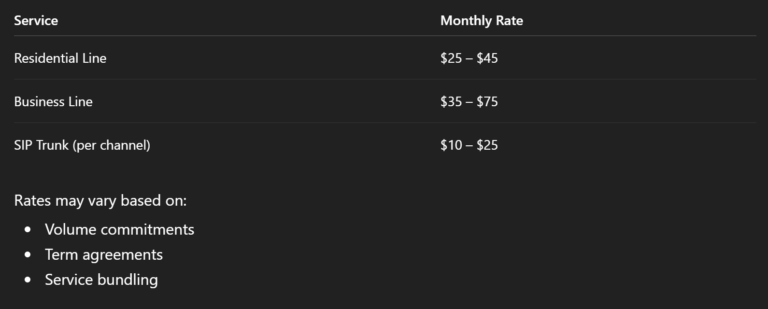
3.1 Local Exchange Rates
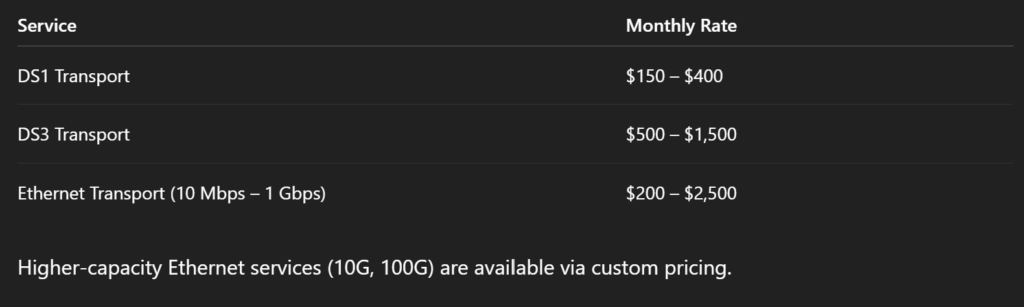
3.2 Access & Transport Services
3.3 Interconnection Charges
Interconnection pricing is determined based on:
- Applicable tariff rates
- Negotiated interconnection agreements
- Traffic volumes and routing architecture
For non-standard deployments, pricing may be established under:
- Individual Case Basis (ICB) arrangements
- Special construction cost recovery
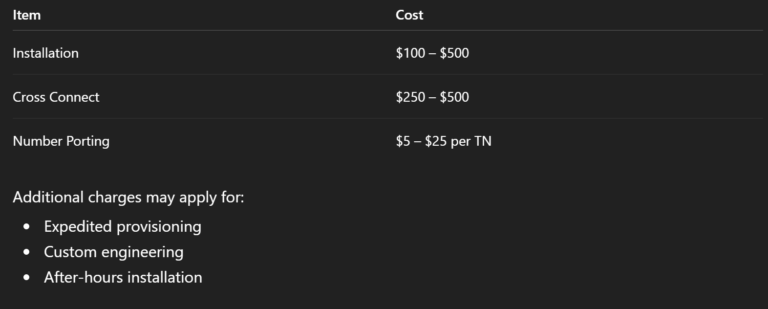
3.4 Non-Recurring Charges (NRC)
SECTION 4 – BILLING & COMPENSATION
4.1 Billing Practices
UpTime365 utilizes industry-standard billing systems and processes, including:
- Monthly recurring charges (MRC)
- Usage-based billing (where applicable)
- Electronic invoicing and reporting
4.2 Intercarrier Compensation
Traffic exchange between carriers is governed by:
- FCC intercarrier compensation rules
- State regulatory requirements
Billing arrangements may include:
- Bill-and-Keep (no mutual compensation)
- Usage-based compensation models
4.3 Dispute Resolution
Billing disputes are handled in accordance with ICA/TEA provisions and must be submitted within defined timeframes. Undisputed charges remain payable.
SECTION 5 – SPECIAL PRICING & COMMERCIAL TERMS
5.1 Volume-Based Pricing
Discounted pricing is available for:
- High-volume customers
- Multi-site deployments
- Carrier wholesale agreements
5.2 Contract-Based Pricing
Term agreements (12–60 months) may include:
- Reduced monthly rates
- Waived installation fees
- Service-level guarantees
5.3 Individual Case Basis (ICB)
Custom solutions may be priced on an Individual Case Basis for:
- Unique network builds
- Large-scale enterprise deployments
- Specialized interconnection scenarios